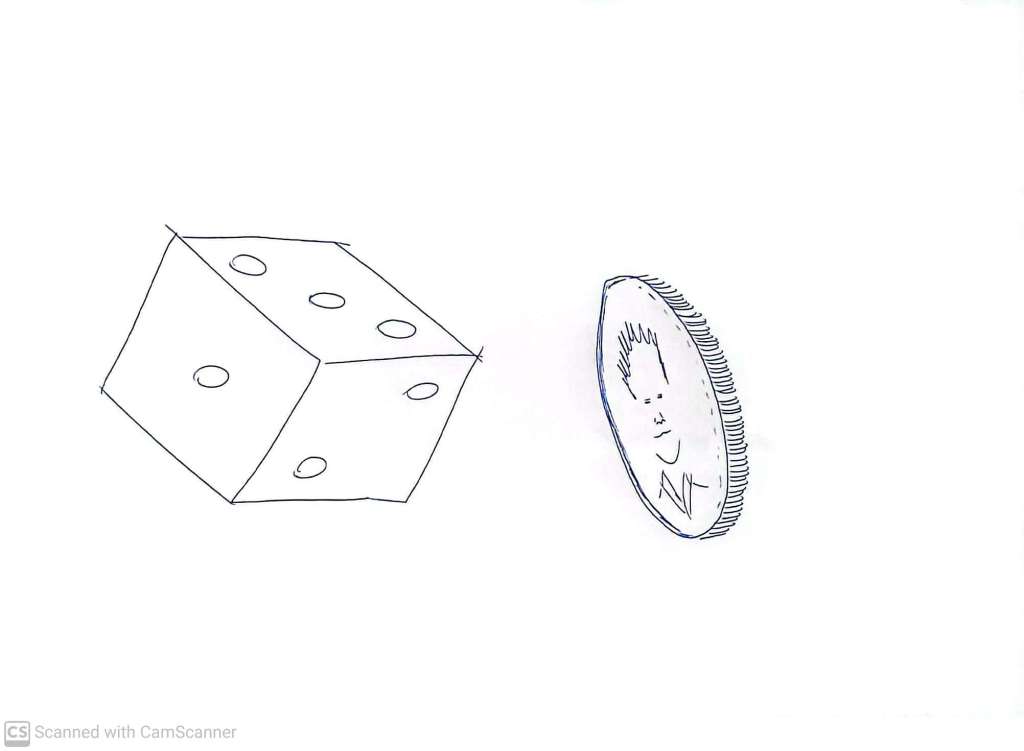
Anyone who’s even contemplated betting on sports events will have heard of ‘odds’. The way it’s used, you can be forgiven if you’re not sure whether it means
- something statistically specific, to do with probabilities, or
- some sort of contractual offer, which captures something visceral, like: I’ll give you 10 to 1 odds that you can’t jump over that puddle.
In fact – the word ‘odds’ is used to hold both of these kinds of meanings, and there is a technically precise link between the two.
If I toss a balanced straight coin, the probability of getting heads and the probability of getting tails should each be one half, i.e.
- there is no sense in which either outcome is more likely than the other
- in the long run, half of all tosses should be heads, and half of all tosses should be tales.
- The probability of getting heads is ½ = 0.5
- The probability of getting tails is ½ = 0.5
In the language of betting, we can say things like:
- The odds (when betting on any particular one outcome – heads, for example) are even.
- The odds are 1:1.
- Two people betting on the outcome of a coin toss should be facing equal investment/risk and equal payout/reward
In a fair bet between people who play as equals (which is not what happens when you go to a casino) if I bet a dollar on heads, my opponent will be betting one dollar on tails. We can argue about whether it matters who ‘calls it’ – but it doesn’t. If the toss turns out to be heads, I get my dollar back, PLUS the additional dollar which my opponent put in.
Now let’s have six of us each bet a dollar on one of the six outcomes the roll of a balanced die. (Yes – it’s one die, multiple dice.) We can still argue about how we decide who gets which number – but it doesn’t matter. If my number comes up, I take the pot. I get my dollar back, and I get the other five dollars put up by the other participants. When a bet yields 5 dollars profit for each dollar bet, then in betting language that is called a bet offering 5 to 1 odds. When what I’m betting on is 1 of N equally likely outcomes, the probability of winning is
- 1 in N, or
- 1/N
If N of us are betting, each placing one bet on a different one of the N equally likely outcome, then when someone gets the pot, they are making a profit of N-1. The first dollar they get just covers their input cost. The probability of obtaining any particular one of N equally likely outcomes is 1/N.
So a probability of 1/N corresponds, in a fair balanced bet, to odds of N-1 to 1, also written as (N-1): 1.
Statisticians, and many others who do not specifically claim to ‘be’ statisticians talk a lot about probabilities (and many other related things) by using quite specific technical terms. They also talk about odds, and when they say odds, it really is just a way of talking about probabilities in terms of the corresponding ‘fair’ betting odds – with one tiny twist.
Of course, not every probability can be expressed as one outcome of N equally likely outcomes. The usual way of speaking formally about probabilities uses the conceptual crutch of some sort of process which we initiate, which can have various outcomes over which we have limited control. An occurrence/instance of this process is often called a trial.
If, in some secret ballot, 70 people vote for candidate A, and 30 people vote for candidate B, I can invent the ‘trial’ of dipping in to the well-mixed ballot box and blindly pulling out a ballot paper. Then we can say things like:
- The probability of drawing a ballot paper marked for A is 70%, or 0.7.
- The probability of ‘the outcome of the trial’ ‘being A’ is 70%
- The probability that the outcome of the trial is A is 70%
- If we repeat the trial many times, and each time put the drawn ballot paper back in the box and give it a good mix to reset the standard conditions for the trial, then we expect 70% of trials to result in A.
- The statistician’s odds of getting an A are 70 to 30, or 70:30, or 7:3, or
or 7/3, or 2.333…
Generically, the statisticians odds of a particular outcome of a trial means the ratio of
- the probability of obtaining the particular chosen outcome (call it P), and
- the probability of obtaining any other other outcome, which is then (1-P).
So the following are equivalent:
- a probability P
- a ‘statisticians odds’ of P/(1-P)
But what would be the fair ‘betting odds’? How much profit would I make if I bet one dollar on A, in a fair bet, and I win? Well, if I bet one dollar on each of the ballots marked for A, and someone else agrees to bet one dollar on each of the ballots marked B, then whoever’s letter comes up takes the pot of 100 dollars. I would earn a profit of 30 dollars, on a bet of 70 dollars. Making 30 dollars for every 70 dollars which I bet means making 30/70 dollars for every one dollar I bet. So the betting odds are 3/7, whereas the statisticians odd are 7/3
. Not quite the same numbers, but I can always translate back and forth between the two. These two formulas, along their interpretations are said to be dual to each other. We are talking about nominally different definitions and calculations (mathematical models of some kind), but they are fundamentally equivalent. Duality of models/theories is a VERY big deal in some areas of mathematics and theoretical physics. So, just to make life complicated, the following are equivalent:
- A probability of P
- Statistician’s odds of P/(1-P)
- Betting odds of (1-P)/P = (1/P) – 1
Recall the bet on the roll of the die, or the bet on one of N equally likely outcomes. Then P=1/N. Also, the following are equivalent
- Statistician’s odds of Q
- Betting odds of 1/Q
- Probability of Q/(Q+1)
Alas, the following are ALSO equivalent:
- Betting odds of R
- Statistician’s odds of 1/R
- Probability of 1/(R+1)
But real-world betting is not the same as the ‘fair’ manipulation of probabilities into payouts for particular investments/stakes. Sometimes, betting odds have no real formal meaning in terms of probabilities at all, like:
I’ll give you 10 to 1 odds that you can’t jump over that puddle.
That just means that I offer pay you 10 dollars if you make the jump, against the promise that you’ll pay me one dollar if you try and fail. No one necessarily has any reliable idea about the probability that you will make the jump. I just made up that number because I thought you had little chance of making it, and perhaps I could induce you to try, for the lure of ten bucks, at the risk of only losing one – plus of course the risk of getting wet! I’m not really interested in your one dollar. I just want to laugh at you landing in the puddle. There are those who think we can quantify everything, even the cost of a human life, or the cost human health, or the cost of getting wet in a puddle, but …
People/businesses who/which handle bets for a living are usually called bookmakers, or bookies. The way they calculate the odds they offer is different from the ‘fair’ calculations we discussed above. It’s a lot more complex, so let’s start simple: imagine a boxing match where I, the bookie, have a bunch of customers collectively putting 70 thousand dollars on a guy called May, and another bunch of customers who have bet a grand total of 30 thousand dollars on a guy called Mac. If they were all agreeable to my evil scheme, I would take 20 thousand dollars for me, and when we know who’s won, I’d pay out the remaining 80 thousand evenly to people who bet on the winner – in proportion to how much each person has bet. This has little to do with probabilities. I just make money for doing nothing more than helping some people get excited about the possibility of winning some money on a boxing match. I take no risks.
Of course, betting people usually don’t put down their money, then wait for the betting to close, and then have the bookie tell them what the return will be on their bet, should they bet correctly. They want to know what betting odds I am ‘offering’ before they decide whether to bet at all, or to wager 10 dollars, or 100.
Interestingly, there used to be, and for all I know, there still is, a betting system at some horse races where, instead of betting ‘with a bookmaker’ you place your bet ‘with the racecourse’. This is almost exactly my evil plan from above: The racecourse management take a nice slice of the total pot, and pay the rest out to those who hold winning tickets, in proportion to how much they bet. It’s considered a more conservative way to bet – the racecourse doesn’t invest heavily in fiddling the odds from minute to minute, but they take no risks at all. For gamblers, there may be less gouging than with the bookmakers, and the whole experience is a bit more like a lottery. The ‘serious’ gamblers go to bookmakers.
Bookmakers have systems for constantly adjusting the odds they offer, as the bets accumulate this way and that on various boxers, horses, or football teams. They don’t like risk, and they can just about completely insulate themselves against it.
Casinos are different – they operate on systems where the probabilities are in fact known, and they don’t get to offer different odds to each new customer, depending on how the betting has gone so far.
A roulette wheel usually has the numbers 0 to 36, coloured black and red. The 0 is special, and is considered neither even or odd, neither high or low, and neither red or black (often green). The house offers all sorts of standard odds on various bets – and these odds would be ‘fair’ if there were not a 0 on the wheel. That little zero is quite important, because it fundamentally tilts the odds in favour of the house.
It is, in principle, possible for a casino to lose a large amount of money if some lucky person repeatedly bets huge sums of on relatively ‘long shot’ bets like that the roulette wheel will specifically give a 13 – but in practice that just doesn’t happen because the statistician’s odds for that are very, very small.
But that little odds-tilting-zero is not the only reason the house always wins in the long run. Many have stumbled upon what they think is a guaranteed way of getting money out of a roulette table. Betting on red versus black (it doesn’t matter which one) pays even odds. If you correctly bet one chip, you get it back, plus one more of the same value. The supposed ‘system’ is something like this:
- Bet one chip
- If you win – you get your chip back and one more, and you can walk away with your earnings of one chip.
- If you lose – you are now ‘in a hole’ of one chip – so now bet two chips on an equivalent (even odds) bet.
- If you win this 2-chip bet, you get those two chips back, plus two more. The profit of two chips from this bet covers the hole of one which you were in, and gives you an overall profit of one – so you can walk away with your net earnings of one chip
- If you loose the 2-chip bet, you are now in a 3 chip hole – so bet 4 chips on an even odds outcome.
- If you win the 4-chip bet, you get a profit of 4 on that bet, which gets you out of your 3 chip hole and gives you one extra – and you can walk away with your net earnings of one chip
- If you lose the 4-chip bet, you deepen your hole from 3 to 7 – so bet 8 chips
- …
There is nothing wrong with the arithmetic or the pattern – doubling your bet each time keeps this pattern going, so that when you eventually win, you have a net profit of one chip. You may also have noticed that every time you extract one chip, you can put it aside, and you are back where you started, so you can do the whole thing again, extract one more chip, and so one – as often as you want.
Does it work? No – for several reasons which would apply even if there were not a 0 on the wheel. Firstly, any particular roulette table has lower and upper limits on what you can bet. These are never vastly different. So if the minimum bet is ten units of whatever currency we are operating with, the maximum bid may be something like 1000, for example – maybe less. You don’t need to be in a very long losing streak to face the situation where your next doubling takes you over the table limit. You could go off to another table, but there will be a maximum bet available in the casino – and you may be surprised how quickly you can get either to that limit, or the limit of your stack of chips.
The house has lots of cash and can easily weather a little bad run of someone being crazy lucky a few bets in a row. However, if you want to use this system to extract 100 dollars, and you want to be 99 percent sure that your stack of chips doesn’t run out in a losing streak, you would need to start with about 5,000 dollars of chips. Whatever amount you want to make – if you want less than a 1% chance/risk/probability of losing your initial stack, that stack will need to be about 50 times as big as your planned profit. If you want to make 100 dollars, it makes no real difference whether you start with a one dollar bet, hoping to do the whole thing (extract a dollar) one hundred times, or whether you start with a 100 dollar bet and keep doubling until you win once. It makes little sense to go to all this trouble, including taking the 1% risk of losing 50 times what you are hoping to make. In any case – if you sit at any real table and play this strategy, the gambling odds are very, very small that someone working in the casino will notice, and that they’ll show you the door.
What are the odds that the house ends the night with a loss? Depending on how you read that, it’s too close to 0, or too large, to construct a reasonable estimate.
 Ysis
Ysis 
One response to “What are the odds?”
[…] In a previous post, we posed the following exercise to revise concepts from a yet earlier post […]